

Using Your Drug Plan for the First Time

Using your Part D plan

For many people, getting enrolled in Medicare seems to be the hard part. But, it isn’t completely smooth sailing after enrollment. There are some things you need to know before using your coverage. It isn’t complicated, but you should be aware of these things.


What Do You Need To Take With You?


  1. Your Medicare Card
  2. A Photo ID
  3. Your Plan Membership Card


Automatic Refill Plans (for mail-order service)


Many people who have Medicare benefits receive their prescriptions with an automatic refill option. This allowance delivers prescriptions to be refilled before they run out. In the past, some drug plans weren’t checking to make sure that customers wanted or needed the offered prescriptions, so they created waste and unnecessary additional costs for those with Medicare and its drug coverage (Part D).


Today, plans must receive a recipient’s approval to deliver a prescription, whether it is a new one or a refill, unless the request is made when the prescription is created. Some plans request this every year, others ask for this before delivery.


This policy doesn’t affect refill programs that the recipient picks up, and it doesn’t apply to long-term care pharmacies that give out and deliver prescription drugs. This new policy might be a change for anyone who has received their prescriptions via mail order and have not had the opportunity to confirm that they still need prescriptions.


Medicare recipients should always check if they receive any prescriptions that are unwanted via an automated delivery program. If you were, in fact, charged for a prescription that you did not request, you might be eligible for a refund. If you can’t resolve an issue with the plan or you wish to file a complaint, you are always welcome to call us for help.


When you apply to use your drug plan for the first time, you will need to provide your plan with certain documentation. These documents can include:


  • A purple notice from Medicare that states you automatically qualify for Extra Help
  • A green or yellow automatic enrollment notice from Medicare
  • An Extra Help “Notice of Award” from Social Security
  • An orange notice from Medicare that says your copayment amount will change next year
  • If you have Supplemental Security Income (SSI), you can use your award letter from Social Security to confirm that you are receiving Social Security benefits.
  • Proof of Medicaid coverage, living in an institution, or proof that you receive home- and community-based services:
  • A bill from an institution such as a nursing home or a state document showing that Medicaid has paid for your stay for at least one month
  • A printout from your state’s Medicaid system showing you have lived in an institution for at least one month
  • A document from your state that shows you have Medicaid and are receiving home- and community-based services


Once you provide your plan with this information, your plan must:


  • Make sure you pay no more than the LIS drug coverage cost limit. For example, in 2022, prescription costs cannot exceed $3.95 for each generic or $9.85 for each brand-name drug covered for the enrollment in the program
  • Contact Medicare for confirmation if it’s available. Processing takes up to two weeks after application, depending on the circumstances.


Privacy and security of the health information of any applicant should be the primary concern of patients and their family members, health care providers, professionals, and the government. Federal law requires anyone who handles health information to protect such data regardless of its storage method. This is required by the Health Insurance Portability and Accountability Act of 1996 (HIPPA). You may have additional protections and rights under your state’s laws.


Using Network Pharmacies


Medicare prescription plans have contracts with other pharmacies that operate within their networks. These operate to provide you with better service. Medicare drug plans also work with these “network pharmacies” to offer lower prices to their enrollees.


Your plan’s network, along with retail pharmacies, might offer a mail order program or an option for retail pharmacies to supply an additional two- or three-month supply of your prescriptions.


  • Preferred pharmacies: If your plan has preferred pharmacies, you could save money on out-of-pocket expenses
  • Mail order programs: Some plans may offer mail order programs that will provide you with a three-month supply of your prescriptions. These will be sent directly to your home.
  • Retail pharmacy programs: Some retail pharmacies offer a two- or three-month supply of any covered prescriptions.


Seniors Health is Here to Help You


When you let us help you enroll, we are always here for you. Anytime you have questions about coverage, or are concerned about changes in your needs we are only a phone call away.

When it comes time to use your plan for the first time, don’t be embarrassed to call and clarify how to do so the right way. At the end of the day, we are here to help you.

Please share this article if you found it helpful, or fill out the the contact form on my contact page to request assistance. You can also feel free to call or text me to get your questions answered.

Picture of two medicare beneficiaries on a laptop review their Medicare options.
September 7, 2025
Many people find the Annual Enrollment Period quite confusing, so we created an easy-to-follow checklist to help guide you through it. Things to know about the Annual Enrollment Period When is the Medicare Annual Enrollment Period? It is a period that runs from October 15th to December 7th each year. It is important to keep in mind your Medicare Supplement (Medigap) policy will not be affected during this time. Medigap benefits remain the same each year. However, you can shop rates if you're looking for lower premiums. Medicare Advantage plans (Part C) and Prescription Drug Plans (Part D) DO change. These plans must renew their contracts with Medicare annually, which allows them to change premiums, co-pays, networks and drug formularies. Therefore, it is essential to review and understand any upcoming changes to your plan. The Annual Enrollment Period (AEP) is your opportunity to decide whether to keep your current plan or switch to a new one. 5 Steps to take during the Annual Enrollment Period 1. Review your annual notice of change letter Your plan is required to send you an Annual Notice of Change packet by the end of September. Take the time to review any upcoming changes to your plan and decide if you want to explore new options for more benefits or lower premiums. If you are satisfied with your current plan, no action is needed. It will automatically renew on January 1st. 2. Compare your prescription drug costs Your plan may change the costs of your prescription medications each year. It is recommended to review your Annual Notice of Change letter to ensure that all of your out-of-pocket drug costs remain affordable. 3. Verify that your doctors are in network Medicare Advantage (Part C) plans have networks. Each plan offers a directory of network providers you can search to see who participates in the plan’s network. Doctors can leave a Medicare Advantage plan network at any time. Even if you aren't changing plans, make sure to check that your doctors are still in network with your current plan. 4. Decide if your plan still meet your healthcare needs Medicare health plans can introduce new benefits and services each year. These benefits may include dental, vision, hearing, fitness memberships, transportation services, among other programs that can help you save on your Medicare premium. Most importantly, comparing these new offerings can help you find the coverage that’s most suitable for your needs. Last but not least - Don’t miss the deadline 5. Schedule a No-Cost Annual Medicare Review Now that you know how the Medicare Annual Enrollment Period (AEP) works, it is time to schedule a date on your calendar to review your choices. Our team at Seniors Health can help you weigh your options, so you can make an informed decision. Representing dozens of top-rated carriers, we can help you compare plans, run quotes and find the most cost-effective plan in your area. Best of all - Our service is free and our team is here to ensure that you are getting the most out of your Medicare coverage. Please do not hesitate to reach out. You can call Monday through Friday - anytime from 9:00 am to 5:00 pm at 855-278-2700. We hope you found this information helpful and we look forward to assisting you. Have questions? Contact a Seniors Health agent today and let us know how we can help.
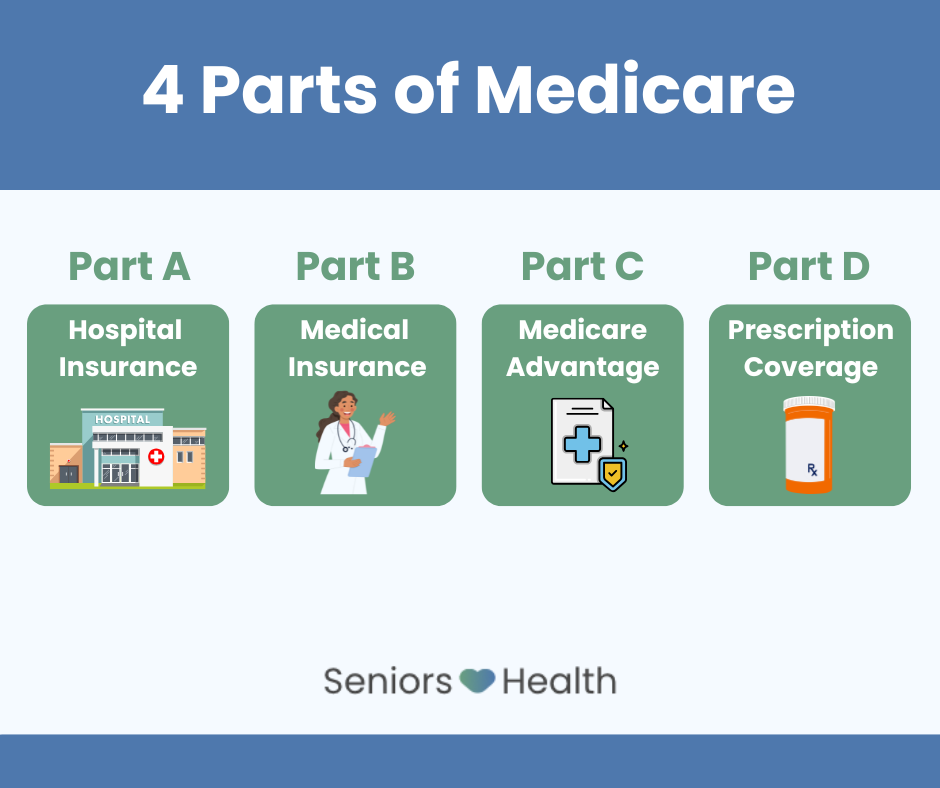
Diagram of the 4 parts of Medicare (Part A, B, C and D), including icons representing each part.
July 21, 2025
Medicare is the federal health insurance program for people 65 and over, some younger with disabilities and those with End Stage Renal Disease. Medicare is a different program from Medicaid, which offers healthcare and services to those who meet the qualified lower income requirements. Anyone receiving Social Security Disability (SSDI) for 24 months, will also become eligible for Medicare. When discussing some of the Medicare basics, It’s important to know that there are 4 Parts of Medicare and each part works in a unique way to help cover your healthcare expenses. What Is Medicare Part A and What Does It Cover? Medicare Part A is inpatient and hospital insurance. Part A helps cover: Inpatient hospital care Skilled nursing facility care Hospice care Some home health care What is Medicare Part B and What Does It Cover? Medicare Part B is outpatient medical insurance. Part B helps cover: Services from a doctor Outpatient care Durable medical equipment Preventative services Some home health care What Is Medicare Part C? Medicare Part C (Medicare Advantage) are privately managed, federally approved Medicare plans. Part C plans combine the benefits of Part A and B into one plan and may also include: Prescription drug coverage Dental, vision and hearing coverage Wellness programs and telehealth services What Is Medicare Part D? Medicare Part D plans provide beneficiaries with privately managed, federally approved prescription drug coverage. Medicare Part A and B do not offer prescription drug coverage, so Part D helps: Manage prescription drug costs Provide lower cost-sharing for in-network and preferred pharmacies What does Medicare Pay? Medicare generally covers 80% of your Part A and Part B medical costs. You are responsible for the remaining 20%. There is no limit on what you pay out of pocket, unless you have Medicare Supplement coverage, also known as Medigap. You could also choose to get your coverage through a Medicare Advantage plan, also known as Part C. It is important to understand how each of these coverages work, when making a decision on how you would like to receive your benefits. New to Medicare with Employer Coverage? You should consider whether it makes sense to keep your employer coverage alongside Medicare or if switching to Medicare as your primary insurance would be a better option. A few key questions would include: How large or small is the employer? How much is your monthly premium? Would you like to have more freedom to choose any provider that accepts Medicare? When it comes to Medicare, there is no one size fits all. Knowing your situation and what you find important, provides answers that help determine which road may be more suitable for you. Avoid Costly Medicare Mistakes - Get Expert Advice We understand that learning about Medicare can seem confusing. Especially knowing when and how to sign up for each part, to ensure you don’t miss any important deadlines. This is where our team of friendly agents can help. To learn which coverage options best suit your needs and how to avoid unexpected medical costs, contact us for a no-cost personalized review.
An image of a calendar to help people understand the Medicare Enrollment Period Dates.
June 27, 2025
When is the Initial Enrollment Period? (IEP) The Initial Enrollment Period begins 3 months before your 65th birthday month, the month of and 3 months after. The Initial enrollment period is a 7-month window where you enroll into Medicare for the first time. You can choose to enroll in Medicare Part A and/or Part B. You may also be eligible to enroll into a Medicare Advantage Plan or Part D Drug Plan. What if I missed my Initial Medicare Enrollment Period? Missing your initial enrollment period could negatively impact you financially. By not enrolling on time, you may incur a late enrollment penalty. This penalty amount can increase over time or for as long as you are not receiving coverage. If you missed your Initial Enrollment Period, you would have to wait until the General Enrollment Period to be eligible to enroll. When is the Medicare Annual Enrollment Period? (AEP) Medicare’s Annual Enrollment Period begins on October 15th and ends on December 7th. During this time, Medicare beneficiaries can enroll, change or dis-enroll from a Medicare Advantage Plan or Part D (Prescription Drug Plan). If you were not able to enroll in a Medicare plan during your Initial Enrollment Period, this would be your opportunity to explore your options before you miss the deadline. It’s very important to review your current coverage annually to ensure that your health needs are being met for the following year. Do I need to re-enroll in my Medicare plan every year? Generally, you will be automatically enrolled into your current Medicare plan every year, unless you feel that your Medicare plan no longer meets your budget or specific goals. If you feel that you are missing important benefits such as dental, vision or hearing, then this would be the time of year to compare your options. During this time, you may also find Part D plans that offer lower prescription drug costs. Whether you choose to make changes or not, this is the time to make sure that you are receiving all the benefits being offered in your area and to ask questions (before the December 7th deadline). When is the General Enrollment Period? (GEP) The General Enrollment Period starts on January 1st and ends on March 31st. During this time, you could enroll into Original Medicare, if you missed your Initial Enrollment Period and did not qualify for a Special Enrollment Period. Keep in mind that although you may sign up for Original Medicare, you may be subject to late enrollment penalties. Also, if you would like to enroll into a Medicare Advantage or Medicare Part D (Prescription Drug coverage) during this time, you will have to wait until the Annual Enrollment Period to be eligible. When is the Medicare Advantage Open Enrollment Period? (MA OEP) The Medicare Advantage Open Enrollment Period begins on January 1st and ends on March 31st. This Open Enrollment Period is for beneficiaries who are already enrolled in a Medicare Advantage Plan and want to leave or change to a different Medicare Advantage Plan. Also, you may switch back to Original Medicare with or without Part D drug coverage. However, you will not be able to change from a Part D to another Part D (Prescription Drug) Plan. What is a Special Enrollment Period? (SEP) The Medicare Special Enrollment Period (SEP) is an 8-month period that begins the month you or your spouse retire from work, or the month that your group coverage ends (whichever comes first). If you’ve had health coverage through your employer, you can enroll in Part A and/or Part B, since you’ve had creditable coverage through a group health plan. There are certain circumstances that can make you eligible for a Special Election Period. If you have moved outside of your plan’s service area, you will have two months to make changes to your coverage. When is the Medigap Open Enrollment Period? This period automatically starts the first month you have Medicare Part B and you’re 65 or older. During this 6-month Medigap Open Enrollment Period, those looking to buy a Medigap Policy will generally get better pricing and have more available choices. During this period, you can get a Medigap policy sold in your state, even if you have health problems. After this enrollment period ends, you may not be able to buy a Medigap policy if you are unable to pass a medical underwriting review. Can I change Medigap plans anytime during the year? You may be able to change your Medigap plan during the year, but this depends on your overall health and if you are able to qualify for a new policy. If you haven't compared plans or premiums in a while, doing so could lead to a great opportunity for savings. Get Help with Your Medicare Options We understand that everyone’s situation is unique and it can be a bit overwhelming to make this important decision on your own. This is where we can help. We are experts when it comes to simplifying Medicare and we provide each beneficiary with a no cost Medicare review. This helps us understand your specific health needs, budget and we can help determine what may be the perfect plan for you. Whether you are retired, about to retire, new to Medicare or currently looking at your options, we’d love to help and answer all your questions and help you understand your choices.