


Medicare 101 Part 2

Medicare 101 Part 2

Just to pick up where we left off, we went over the Enrollment Periods so that you can have a good idea as to when you should start taking the steps you need to enroll. Please feel free to go back to that article in case you need a refresher. For this post, we are going to dive into explaining what Medicare actually pays for.


So What Does Medicare Actually Pay for?


We will start with Medicare Part A, and what it pays for. Medicare Part A is hospital coverage; it covers hospitalization, in-patient procedures, mental health care, skilled nursing, home/hospice care, and also some blood for in-patient care.


For Hospital visits in Part A, what you pay is based on the number of days of your stay.


For days 1 through 60, you will pay a 1,280 dollar deductible.


Then, for days 61 through 90, you will pay a 320 dollar co-pay for every day you spend in the hospital.


After that, for days 91 through 150, you will have to pay 640 dollars per day. The article continues below.


After 150 days in the hospital, you will have to pay for everything. Since skilled nursing is covered under Part A, you also have some coverage and it is based on the number of days you use the skilled nursing care.


For days 1 through 20, you don’t have to pay anything for skilled nursing case. It is covered by your Medicare Part A. Then, for days 21 through 100, you will pay 160 dollars per day. After day 100 however, you will be responsible for all costs.


Moving on, let’s talk about what is covered under Medicare Part B, and what you can expect to pay, and what will be covered. If you need a refresher on the things covered by Medicare Part A, B, C, and D, you can take a look at our articles here! We wrote them just for people who need some information about these things.


Medicare Part B


In case you weren’t sure, Medicare Part B is the medical part of Medicare. Part B covers things like doctor visits, some outpatient procedures, ambulance rides, x-rays, and quite a few other things. You can learn more about the specifics using the "Medicare Overview" button above.


What you pay under Medicare Part B is a bit more straightforward than Part A. You will pay 20% of any Medicare-approved amount for medical under Part B. There is also a deductible to pay every year. The Part B deductible usually increases, or otherwise changes, every year.


It is important to know that these costs are IN ADDITION to whatever costs you have for your Part B monthly premium. The Medicare Part B premium is the same for all people and also tends to change (usually increase slightly) every year.


Key Takeaways about Medicare Part B

Part B is where many folks make a common mistake. If you don’t enroll in Part B when you are supposed to, you will be penalized later when you actually do need it. If you aren’t sure when to enroll in Part B, we are happy to speak with you and figure out what your situation is. Some people can delay their enrollment in Part B, but it isn’t just as simple as doing nothing.


Especially when it comes to Part B, you should make sure you are 100% sure of your status. The best way to do this is to reach out to Seniors Health and get a free consultation. Usually within a few minutes of us speaking, we can tell you what would be best for you. After that, we can help you do what you need to do, or simply give you the steps you can take to do it yourself!


Why work with Seniors Health on your Medicare Enrollment


Another key takeaway is that Medicare is not the end-all, be-all, of health insurance. It doesn’t cover everything, and you will still be responsible for some costs. Sometimes this fact surprises folks, as they expected to be covered 100% by Medicare as they turned 65. If you’re reading this article and made it this far, you are already ahead of the game. Being informed as you approach Medicare will save you a lot of time, as well as preventing you from stressing out about health coverage at a time when you may need it.


If you feel you are ready to begin the process, you can reach out to me via phone, email, or text message and we will be happy to help you. Our goal at Seniors Health is not to sell you anything – we want to inform you of your options, so that you can make the best choices for yourself. We use our years of experience to help people do just that.

Picture of two medicare beneficiaries on a laptop review their Medicare options.
September 7, 2025
Many people find the Annual Enrollment Period quite confusing, so we created an easy-to-follow checklist to help guide you through it. Things to know about the Annual Enrollment Period When is the Medicare Annual Enrollment Period? It is a period that runs from October 15th to December 7th each year. It is important to keep in mind your Medicare Supplement (Medigap) policy will not be affected during this time. Medigap benefits remain the same each year. However, you can shop rates if you're looking for lower premiums. Medicare Advantage plans (Part C) and Prescription Drug Plans (Part D) DO change. These plans must renew their contracts with Medicare annually, which allows them to change premiums, co-pays, networks and drug formularies. Therefore, it is essential to review and understand any upcoming changes to your plan. The Annual Enrollment Period (AEP) is your opportunity to decide whether to keep your current plan or switch to a new one. 5 Steps to take during the Annual Enrollment Period 1. Review your annual notice of change letter Your plan is required to send you an Annual Notice of Change packet by the end of September. Take the time to review any upcoming changes to your plan and decide if you want to explore new options for more benefits or lower premiums. If you are satisfied with your current plan, no action is needed. It will automatically renew on January 1st. 2. Compare your prescription drug costs Your plan may change the costs of your prescription medications each year. It is recommended to review your Annual Notice of Change letter to ensure that all of your out-of-pocket drug costs remain affordable. 3. Verify that your doctors are in network Medicare Advantage (Part C) plans have networks. Each plan offers a directory of network providers you can search to see who participates in the plan’s network. Doctors can leave a Medicare Advantage plan network at any time. Even if you aren't changing plans, make sure to check that your doctors are still in network with your current plan. 4. Decide if your plan still meet your healthcare needs Medicare health plans can introduce new benefits and services each year. These benefits may include dental, vision, hearing, fitness memberships, transportation services, among other programs that can help you save on your Medicare premium. Most importantly, comparing these new offerings can help you find the coverage that’s most suitable for your needs. Last but not least - Don’t miss the deadline 5. Schedule a No-Cost Annual Medicare Review Now that you know how the Medicare Annual Enrollment Period (AEP) works, it is time to schedule a date on your calendar to review your choices. Our team at Seniors Health can help you weigh your options, so you can make an informed decision. Representing dozens of top-rated carriers, we can help you compare plans, run quotes and find the most cost-effective plan in your area. Best of all - Our service is free and our team is here to ensure that you are getting the most out of your Medicare coverage. Please do not hesitate to reach out. You can call Monday through Friday - anytime from 9:00 am to 5:00 pm at 855-278-2700. We hope you found this information helpful and we look forward to assisting you. Have questions? Contact a Seniors Health agent today and let us know how we can help.
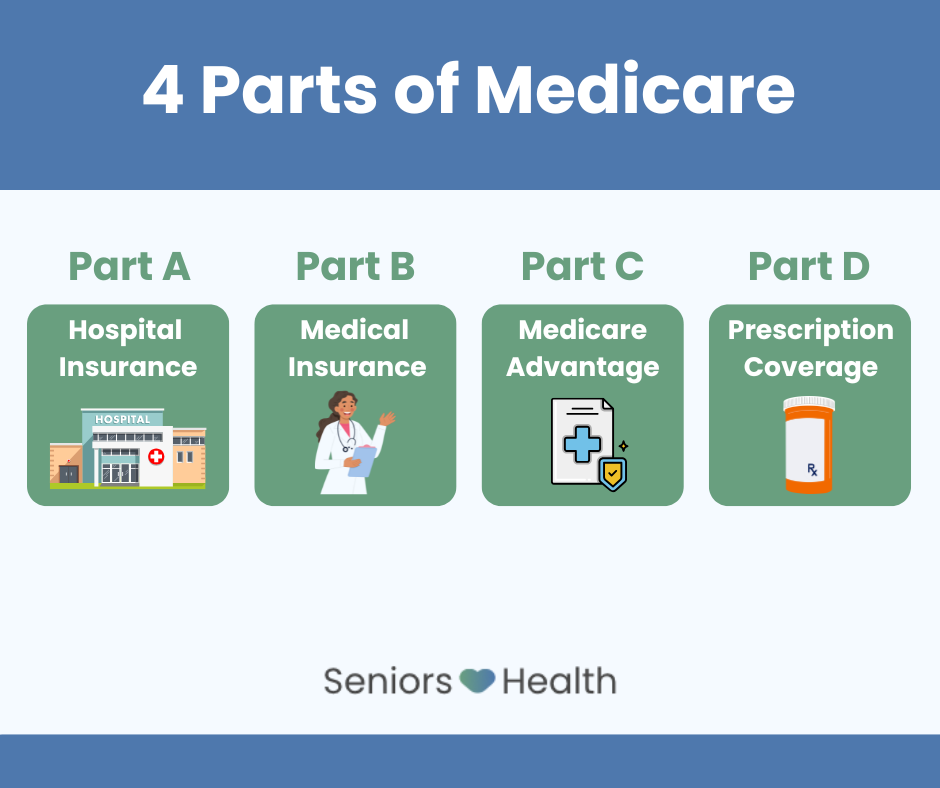
Diagram of the 4 parts of Medicare (Part A, B, C and D), including icons representing each part.
July 21, 2025
Medicare is the federal health insurance program for people 65 and over, some younger with disabilities and those with End Stage Renal Disease. Medicare is a different program from Medicaid, which offers healthcare and services to those who meet the qualified lower income requirements. Anyone receiving Social Security Disability (SSDI) for 24 months, will also become eligible for Medicare. When discussing some of the Medicare basics, It’s important to know that there are 4 Parts of Medicare and each part works in a unique way to help cover your healthcare expenses. What Is Medicare Part A and What Does It Cover? Medicare Part A is inpatient and hospital insurance. Part A helps cover: Inpatient hospital care Skilled nursing facility care Hospice care Some home health care What is Medicare Part B and What Does It Cover? Medicare Part B is outpatient medical insurance. Part B helps cover: Services from a doctor Outpatient care Durable medical equipment Preventative services Some home health care What Is Medicare Part C? Medicare Part C (Medicare Advantage) are privately managed, federally approved Medicare plans. Part C plans combine the benefits of Part A and B into one plan and may also include: Prescription drug coverage Dental, vision and hearing coverage Wellness programs and telehealth services What Is Medicare Part D? Medicare Part D plans provide beneficiaries with privately managed, federally approved prescription drug coverage. Medicare Part A and B do not offer prescription drug coverage, so Part D helps: Manage prescription drug costs Provide lower cost-sharing for in-network and preferred pharmacies What does Medicare Pay? Medicare generally covers 80% of your Part A and Part B medical costs. You are responsible for the remaining 20%. There is no limit on what you pay out of pocket, unless you have Medicare Supplement coverage, also known as Medigap. You could also choose to get your coverage through a Medicare Advantage plan, also known as Part C. It is important to understand how each of these coverages work, when making a decision on how you would like to receive your benefits. New to Medicare with Employer Coverage? You should consider whether it makes sense to keep your employer coverage alongside Medicare or if switching to Medicare as your primary insurance would be a better option. A few key questions would include: How large or small is the employer? How much is your monthly premium? Would you like to have more freedom to choose any provider that accepts Medicare? When it comes to Medicare, there is no one size fits all. Knowing your situation and what you find important, provides answers that help determine which road may be more suitable for you. Avoid Costly Medicare Mistakes - Get Expert Advice We understand that learning about Medicare can seem confusing. Especially knowing when and how to sign up for each part, to ensure you don’t miss any important deadlines. This is where our team of friendly agents can help. To learn which coverage options best suit your needs and how to avoid unexpected medical costs, contact us for a no-cost personalized review.
An image of a calendar to help people understand the Medicare Enrollment Period Dates.
June 27, 2025
When is the Initial Enrollment Period? (IEP) The Initial Enrollment Period begins 3 months before your 65th birthday month, the month of and 3 months after. The Initial enrollment period is a 7-month window where you enroll into Medicare for the first time. You can choose to enroll in Medicare Part A and/or Part B. You may also be eligible to enroll into a Medicare Advantage Plan or Part D Drug Plan. What if I missed my Initial Medicare Enrollment Period? Missing your initial enrollment period could negatively impact you financially. By not enrolling on time, you may incur a late enrollment penalty. This penalty amount can increase over time or for as long as you are not receiving coverage. If you missed your Initial Enrollment Period, you would have to wait until the General Enrollment Period to be eligible to enroll. When is the Medicare Annual Enrollment Period? (AEP) Medicare’s Annual Enrollment Period begins on October 15th and ends on December 7th. During this time, Medicare beneficiaries can enroll, change or dis-enroll from a Medicare Advantage Plan or Part D (Prescription Drug Plan). If you were not able to enroll in a Medicare plan during your Initial Enrollment Period, this would be your opportunity to explore your options before you miss the deadline. It’s very important to review your current coverage annually to ensure that your health needs are being met for the following year. Do I need to re-enroll in my Medicare plan every year? Generally, you will be automatically enrolled into your current Medicare plan every year, unless you feel that your Medicare plan no longer meets your budget or specific goals. If you feel that you are missing important benefits such as dental, vision or hearing, then this would be the time of year to compare your options. During this time, you may also find Part D plans that offer lower prescription drug costs. Whether you choose to make changes or not, this is the time to make sure that you are receiving all the benefits being offered in your area and to ask questions (before the December 7th deadline). When is the General Enrollment Period? (GEP) The General Enrollment Period starts on January 1st and ends on March 31st. During this time, you could enroll into Original Medicare, if you missed your Initial Enrollment Period and did not qualify for a Special Enrollment Period. Keep in mind that although you may sign up for Original Medicare, you may be subject to late enrollment penalties. Also, if you would like to enroll into a Medicare Advantage or Medicare Part D (Prescription Drug coverage) during this time, you will have to wait until the Annual Enrollment Period to be eligible. When is the Medicare Advantage Open Enrollment Period? (MA OEP) The Medicare Advantage Open Enrollment Period begins on January 1st and ends on March 31st. This Open Enrollment Period is for beneficiaries who are already enrolled in a Medicare Advantage Plan and want to leave or change to a different Medicare Advantage Plan. Also, you may switch back to Original Medicare with or without Part D drug coverage. However, you will not be able to change from a Part D to another Part D (Prescription Drug) Plan. What is a Special Enrollment Period? (SEP) The Medicare Special Enrollment Period (SEP) is an 8-month period that begins the month you or your spouse retire from work, or the month that your group coverage ends (whichever comes first). If you’ve had health coverage through your employer, you can enroll in Part A and/or Part B, since you’ve had creditable coverage through a group health plan. There are certain circumstances that can make you eligible for a Special Election Period. If you have moved outside of your plan’s service area, you will have two months to make changes to your coverage. When is the Medigap Open Enrollment Period? This period automatically starts the first month you have Medicare Part B and you’re 65 or older. During this 6-month Medigap Open Enrollment Period, those looking to buy a Medigap Policy will generally get better pricing and have more available choices. During this period, you can get a Medigap policy sold in your state, even if you have health problems. After this enrollment period ends, you may not be able to buy a Medigap policy if you are unable to pass a medical underwriting review. Can I change Medigap plans anytime during the year? You may be able to change your Medigap plan during the year, but this depends on your overall health and if you are able to qualify for a new policy. If you haven't compared plans or premiums in a while, doing so could lead to a great opportunity for savings. Get Help with Your Medicare Options We understand that everyone’s situation is unique and it can be a bit overwhelming to make this important decision on your own. This is where we can help. We are experts when it comes to simplifying Medicare and we provide each beneficiary with a no cost Medicare review. This helps us understand your specific health needs, budget and we can help determine what may be the perfect plan for you. Whether you are retired, about to retire, new to Medicare or currently looking at your options, we’d love to help and answer all your questions and help you understand your choices.